Best CRM for Jewelry Stores: What to Look for in 2026
Clientbook, Salesforce, HubSpot, or built-in? Here’s what jewelry stores actually need from a CRM — and why most generic options miss the mark.
- Jewelry CRM needs occasion tracking -- anniversaries, birthdays, and proposal dates
- Wishlists must be tied to real, live inventory -- not a static list of product names
- Purchase history should be visible at the point of sale, not buried in a separate system
- Communication history across all channels -- text, email, phone, in-store -- must live in one place
Every jewelry store has customer data. The question is where it lives. For most independents, it's scattered: some contacts in the POS, some in the owner's phone, a few in a spreadsheet labeled "VIP Clients 2024," and a stack of repair envelopes with handwritten notes about ring sizes and anniversary dates. This isn't a CRM. It's an archaeological dig. When a longtime customer walks in and a new associate has no idea they spent $12,000 last year, you've failed at the most basic job of customer relationship management.
So you start shopping for a CRM. You Google "best CRM for jewelry stores" and get a mix of generic listicles, ads for Salesforce and HubSpot, and a few jewelry-specific options like Clientbook. Each has tradeoffs. Most have fundamental gaps for jewelry retail. Here's what to actually evaluate.
What Generic CRMs Get Wrong
Salesforce is the 800-pound gorilla. It can do anything -- if you have a dedicated admin, a six-figure implementation budget, and six months to customize it. For a three-location jewelry chain doing $4 million a year, that's absurd. You don't need lead scoring algorithms and marketing automation workflows. You need to know that Mrs. Chen's 30th anniversary is in three weeks and she looked at emerald earrings last time she visited.
HubSpot is more accessible but still built for B2B sales funnels and inbound marketing. It thinks in terms of deals, pipelines, and lifecycle stages. Jewelry retail doesn't work that way. Your "pipeline" is a customer who wandered in, tried on four rings, texted their partner a photo, came back a week later with the partner, and bought -- or didn't. Mapping that journey into HubSpot's deal stages is forcing a square peg into a round hole. And neither Salesforce nor HubSpot integrates with your POS, your inventory, or your repair system. They're islands of customer data with no connection to what the customer actually bought, returned, or has on wishlist.
Clientbook: Jewelry-Specific, But Standalone
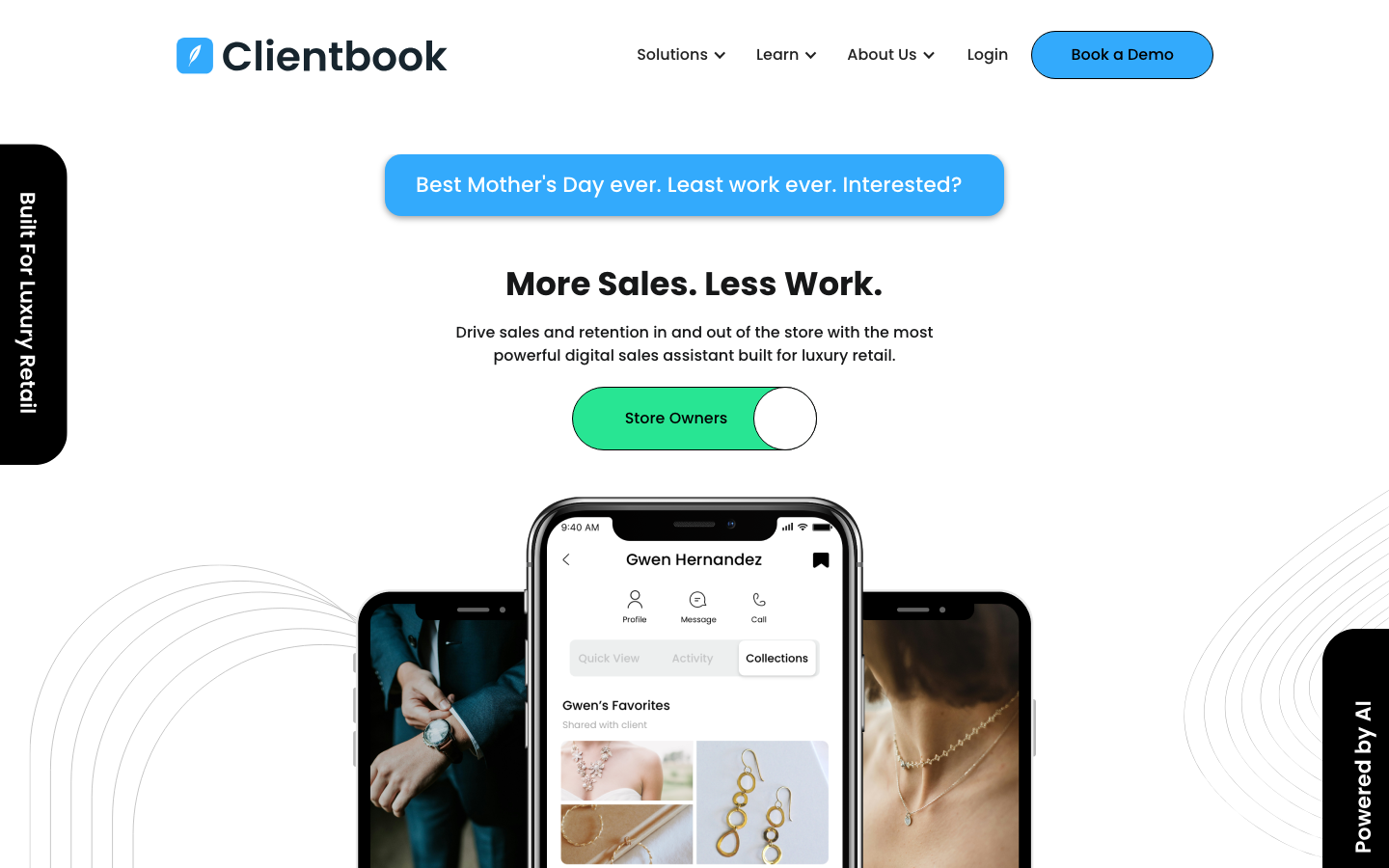
Clientbook gets closer. It was built for high-touch retail clienteling and has real traction in the jewelry space. Sales associates can log interactions, set follow-up reminders, and track client preferences. Pricing runs $300-700 per month depending on store count and features. The product understands that jewelry retail is relationship-driven, and the UX reflects that. But Clientbook is a standalone tool. It sits alongside your POS, not inside it. Your associate switches between the POS to look up inventory, Clientbook to check client history, and maybe a third tool for texting. Customer data lives in Clientbook. Transaction data lives in your POS. Inventory data lives somewhere else. You're paying $300-700 a month for a system that still requires manual stitching to get a complete picture.
What a Jewelry-Specific CRM Actually Looks Like
The right CRM for a jewelry store isn't a separate product. It's a layer within your operating system. When a customer walks in, you pull up their profile and see everything: ring size 7.5, prefers yellow gold, bought a 1.5ct round solitaire in March 2024, anniversary is October 12, has a wishlist with two items (a tennis bracelet and a pair of sapphire studs -- both currently in stock), last visited six weeks ago, last texted three weeks ago asking about layaway options. That profile is built automatically from transactions, communications, and interactions. No manual data entry. No switching between apps. As noted in JCK's coverage of client relationships, the stores that win in jewelry retail are the ones that make every interaction feel personal -- and that requires data at the point of contact, not trapped in a back-office system.
Occasion Tracking Changes the Game
Generic CRMs don't have a concept of "occasions." They have contact fields and maybe a birthday field. Jewelry CRM needs to track birthdays, wedding anniversaries, engagement anniversaries, graduations, milestone birthdays for children, and any custom dates the client mentions ("my wife loves Valentine's Day"). Each occasion is a revenue opportunity if your system surfaces it at the right time. Two weeks before an anniversary, the assigned rep should see it on their dashboard. Not as a calendar reminder they set manually -- as an automated, prioritized prompt with the client's purchase history and preferences attached.
This is where the CRM-POS integration becomes non-negotiable. When the system knows the customer bought a pendant for their wife's birthday last year, it can suggest complementary pieces for this year. When the wishlist is tied to live inventory, the rep can text: "That tennis bracelet you loved is still here -- want me to hold it for your anniversary next month?" That text takes 15 seconds and converts at a dramatically higher rate than any marketing email.
Communication History Across Every Channel
Your customers text you, email you, call you, and walk in. Sometimes all four in the same week. If each channel is a separate silo -- texts in one app, emails in another, phone calls unlogged, in-store conversations forgotten -- no one has a complete picture. The associate working Tuesday doesn't know what the associate working Saturday discussed. A proper jewelry CRM logs every touchpoint in a single timeline: in-store visit notes and purchase history today, with texts, emails, and phone calls (including optional transcription) joining the same timeline as the JewelOps communications layer rolls out. When you open a client profile, the goal is to see the full relationship, not fragments.
The Today Page
One of the most underrated CRM ideas for jewelry is a daily dashboard -- on the JewelOps roadmap, we call it the Today Page -- that tells each rep exactly who to contact and why. Upcoming birthdays and anniversaries, clients who haven't visited in 90+ days, pending follow-ups from previous interactions, repairs ready for pickup. No rep should start their day wondering what to do; the system should tell them. This is where a built-in CRM is designed to pull ahead of Clientbook, HubSpot, or anything else bolted on from the outside. When the CRM, POS, inventory, and communications all share the same database, a dashboard like this can surface insights that a standalone CRM simply cannot generate.
The best CRM for a jewelry store isn't the one with the most features. It's the one that lives where your associates already work, knows what's in your cases, tracks what matters in jewelry (occasions, wishlists, ring sizes, metal preferences), and turns customer data into daily action. If your CRM requires a separate login, a separate subscription, and manual data syncing with your POS, you don't have a CRM. You have another tab to forget to check.